An arts and psychogeography project exploring affect, pareidolia, and monstrosity in the Ashridge Estate, through reportage drawing and photography.
This research and creative project explores how drawing and photography can disrupt conventional representations of landscape—especially those shaped by the nostalgic, pastoral, and picturesque traditions—by engaging with what the author terms the “eerie-weird axis.” Inspired by thinkers like Mark Fisher and W.J.T. Mitchell, the work critiques dominant modes of seeing nature that suppress flux, disturbance, and subjective meaning in favor of aesthetic comfort and ideological control.
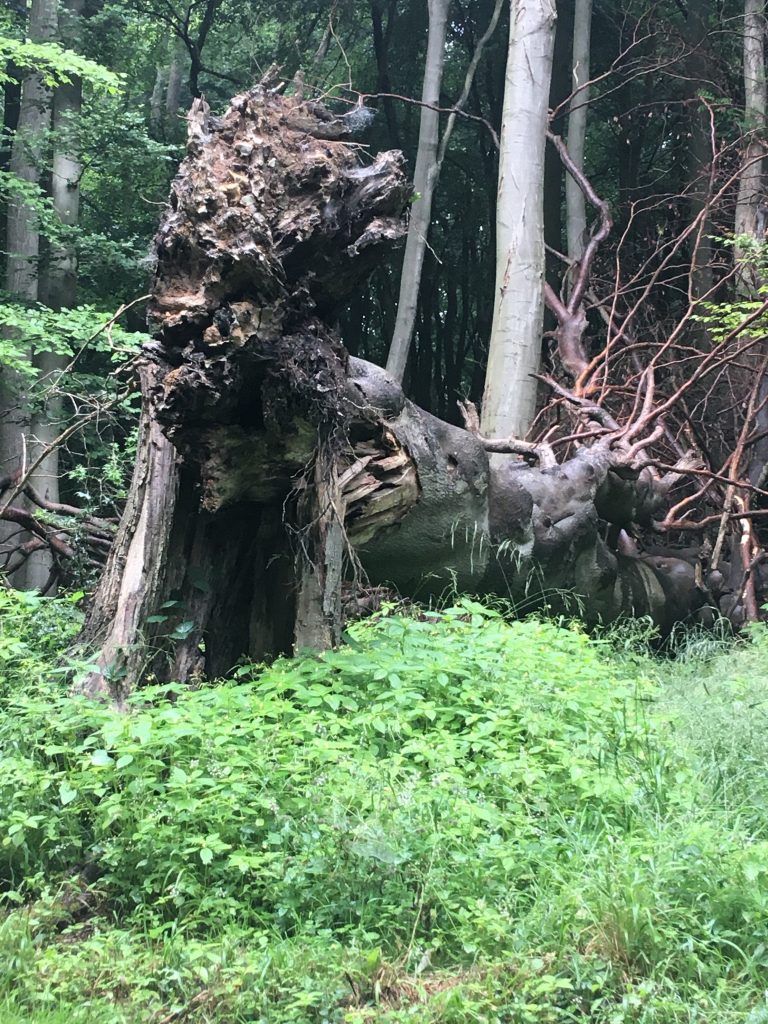
Using reportage drawing, photography, and phenomena like pareidolia (seeing faces or figures in ambiguous forms), the artist records strange or “monstrous” entities found in the Ashridge Estate, a historically and ideologically loaded English landscape. These sightings—fallen trees, twisted branches, odd arrangements—become metaphoric ruptures that challenge the dominant frame through which nature is usually viewed.
The project proposes that these creative disruptions enable better analogues for nature, making visible the temporal, chaotic, and sometimes unsettling aspects of the environment that conventional landscape aesthetics repress. The eerie-weird axis resists fixed meaning, instead inviting curiosity, cognitive flexibility, and alternative ways of being in and perceiving the landscape.
The Instagram page @eerie__weird__axis documents this process, sharing images and drawings that serve both as records of personal encounters and as provocations for viewers to see familiar spaces differently—less as passive scenery, and more as active, unknowable agents.